- SakeenahMD Newsletter
- Posts
- Finding Your Resilience Compass: Between Your Workview and Your Lifeview
Finding Your Resilience Compass: Between Your Workview and Your Lifeview

Ifedolapo Sulyman Olanrewaju
November 02, 2025
As-salam alaykum,
"I’m not sure how to be more present at home with everything that I do at work these days!"
The physician father standing across from me didn't say these exact words, but the weight in his voice made them clear. Just over a week ago, in a gathering of Muslim fathers—many of them physicians—our conversation about illuminating our households with the Qur'an gave way to a more pervasive struggle: the guilt of trading patient care for presence at home with our growing families and our investment in their spiritual foundations.
That struggle is my struggle as well. It's likely yours too.
A female colleague recently approached my wife with a similar tension—asking how her PRN shift work balances with family life and finances. My wife immediately understood. This was the same question we wrestled with a couple of years ago when life designing became a priority for us, when we needed to recalibrate our focus toward akhira and tap into a tawakkul mindset.
Whether you're a father, mother, early in your career, or decades into practice—this tension is universal.
At its core, this is a life design challenge: the challenge of intentionally building our lives using design thinking principles filtered through an Islamic lens.
It also highlights the tension between how we view our work—your workview (why your work matters and what it means to you)—and your lifeview (what gives life meaning beyond work, your deeper purpose and values).
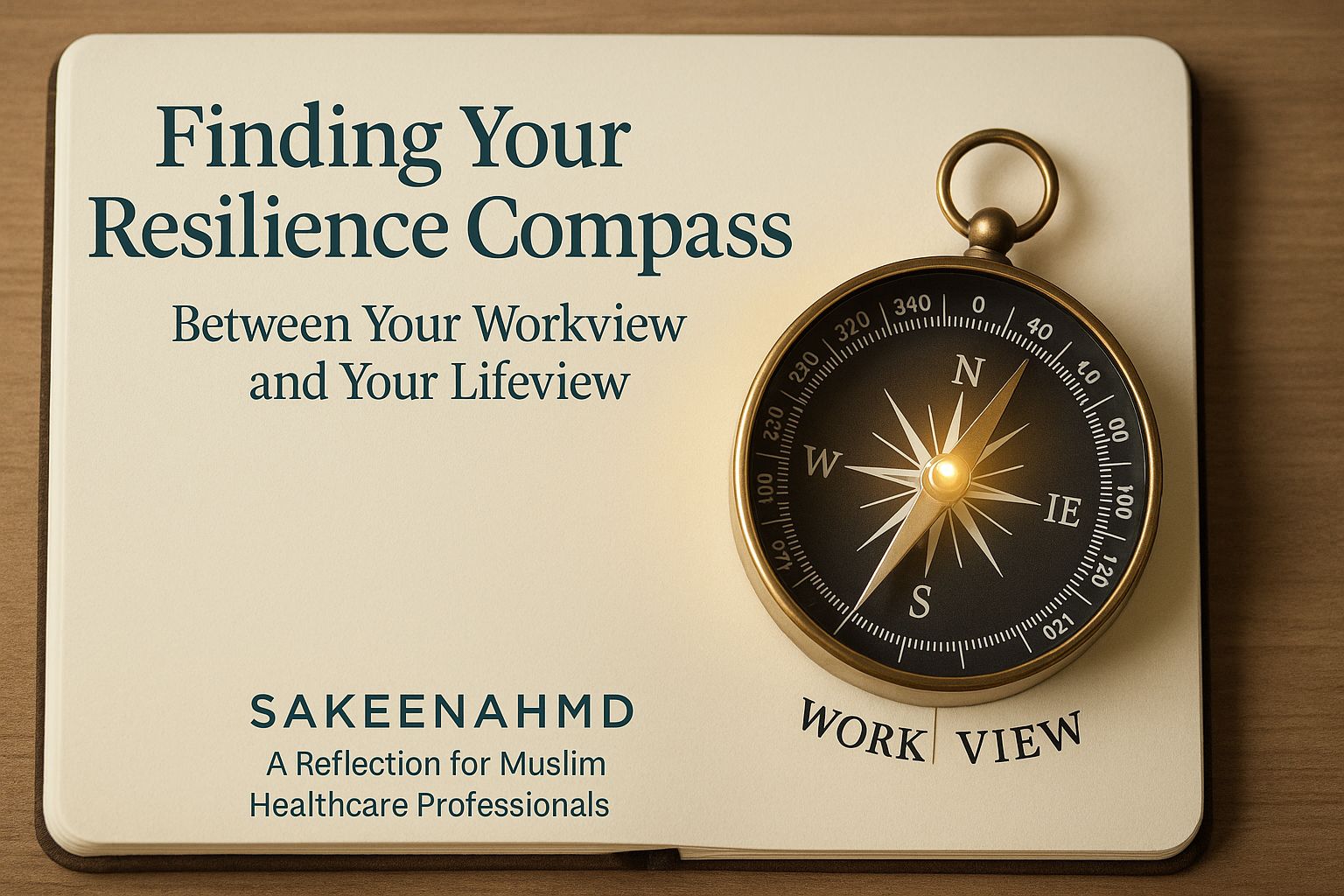
Think of your workview and lifeview as the two poles of a compass. When they point in the same direction, you have true north—a clear sense of purpose that guides decisions and conserves energy. When they're misaligned, you're constantly recalibrating, exhausted by the internal navigation that precedes every choice.
The more aligned these are, the less the tension and the more resilient we tend to be—not to mention what becomes possible in terms of your performance across all of your roles.
A Moment of Authenticity
I can still remember vividly when I attended a medical conference several years ago. The keynote speaker—the CEO of one of the largest healthcare systems in the US—got off stage and was visiting with folks like myself and others who wanted his attention because of how profoundly impactful his message was.
His son walked up to him. He kissed him on the head and hugged him and they made a quick plan to catch up in the next few hours.
That exchange validated his commentary around work-life balance that was addressed in a fireside chat with him. It was a moment of authenticity that I've never forgotten.
Prophetic Wisdom on Presence with Our Families
That scenario also reminded me of Prophet Muhammad's (PBUH) engagement with his daughter, Fatima (RA). Aisha (RA) narrated: "I have not seen anyone more closely resemble the disposition, mannerism, and characteristics of the Messenger of Allah, peace and blessings be upon him, than his daughter Fatimah... If she entered his home, the Prophet would stand for her, take her by the hand, kiss her, and seat her in his place." Jami At-Tirmidhi 3872
Both moments—separated by centuries and vastly different cultures—show us what alignment looks like: leaders whose actions toward family validated their words about what matters.
Back to Our Struggle
It's crucial to solve for this life design challenge because its impact permeates every aspect of our lives with ramifications for the legacy we leave behind with our families.
It also impacts our performance in all arenas of our lives and affects our resilience across all of our roles.
The term "life design" comes from Stanford researchers Dave Evans and Bill Burnett, but the concept is deeply Islamic:
We don't stumble upon our best life—we build it with intentionality and tawakkul (trust in Allah)
We don't get unstuck by repeating the same patterns—we experiment with wisdom and iterate until we achieve the next best version of our lives
We don't wait for perfect clarity—we take imperfect action and trust Allah to guide our steps
Divine Wisdom
Allah says in the Qur’an, Surah Al-Ra'd, Chapter 13, Verse 11:
"...Verily Allah will not change the condition of a people as long as they do not change their state themselves..."
This highlights the importance of self-agency in building a meaningful life—a core principle of life design as a Muslim.
Finding Your True North: Five Critical Steps
To address this struggle between workview and lifeview, here are five critical steps to begin finding your compass alignment today:
1. Acknowledge the Struggle
Like my friend at that gathering, it's okay to be vulnerable with yourself and your close circle about this struggle. What's unhealthy is remaining stuck without acknowledging the reality.
What this looks like in practice: A conversation over chai (tea) with a trusted colleague where you call out the tension. A journal entry after a difficult shift where you missed your daughter's Qur'an recitation. A moment of honest reflection with your spouse about what's not working.
The acknowledgment also has the potential to bring you down on your knees and turn to Allah with sincerity for help—a non-negotiable for the spiritually intelligent and highly successful Muslim healthcare professional.
2. Reframe the Problem
Turn the struggle into a beautiful question. For example: How might I evolve my schedule to make space to take my kids to Asr Salah at least three days a week?
Or: How might I protect one morning a week for Qur'an study without compromising patient care?
Or: How might I structure my PRN shifts to be present for Friday family dinners?
This reframing helps you see actionable solutions instead of insurmountable obstacles.
3. Have a Bias to Action
Don't overthink it. Even small steps count—commit to one day if three days seem too much initially.
Start here: Block one recurring calendar slot this week that's non-negotiable family or spiritual time. For one physician, it's leaving clinic by 5:30 PM on Tuesdays for his son's Qur'an class. For another, it's protecting Saturday morning runs from on-call duty. For a surgeon, it's one surgery-free morning monthly for volunteer work that feeds the soul.
The specific action matters less than the protection of that time as sacred.
Taking action brings barakah, which creates divinely driven momentum for you.
What's your first block?
4. Leverage Your Support System
Engage in radical collaboration by leaning on your resilience companions and Allah, the Most High.
Make dua. Involve your close network—your spouse, a mentor physician who's navigated this before, your practice manager who could help with scheduling, an accountability partner from your community.
In healthcare specifically: Your colleagues understand the constraints better than anyone. The hospitalist who figured out a sustainable call schedule. The primary care physician who restructured their panel size. The nurse practitioner who negotiated clinic hours around school pickup. Learn from those a few steps ahead.
Build forward with intention together.
5. Stay Flexible
Designing your life or work life is iterative. If one attempt fails, tweak it and try again.
A real iteration example: Week 1, you protect Tuesday evenings. By Thursday, you realize your clinic runs late on Tuesdays. Week 2, you shift to Wednesday evenings and talk to your scheduler about blocking your last Wednesday appointment at 4 PM. Week 3, you've successfully made it home for Maghrib three Wednesdays in a row. You notice your daughter lights up when you walk in. That feedback fuels the next iteration.
Focus on your gains, even if they're small, to cultivate gratitude in your heart.
Build slowly with intention and relish who you become on the journey as you realize every next best version of your life.
The Path Forward
I don't know if that physician father has found his compass alignment yet. But I know he took the first step—he named the struggle aloud. And I know that each small iteration, each protected Wednesday evening, each genuine "I'm here" moment with our loved ones, is a victory worth celebrating.
Your compass is recalibrating with every intention you set and every small action you take.
Over the coming weeks, we'll explore each of these five steps more deeply—from articulating your workview and lifeview on paper, to building your resilience network, to navigating the iterations when life inevitably shifts your compass.
For now, start with one small block of protected time this week.
As Muslim healthcare professionals, our Islamic worldview and the Muslim identity that we aspire to for ourselves and our families requires intentionality in a healthcare world of chaos and constantly being on-the-go.
The life design process provides tools for this intentionality so that we continuously evolve toward our next best versions until we meet our Lord.
May Allah, the Most High, assist each one of us on this path of life design that brings us closer to Him and enhances our resilience and performance as healthcare professionals across all of our roles in life and work. Amin.
Sincerely,
Sulyman
P.S.This is the first in a series on life design for Muslim healthcare professionals. Over the next several weeks, we'll dive deeper into each of these five steps with practical tools, real stories, and guided exercises to help you find and maintain your resilience compass. Stay tuned—and if you can't wait, join the SakeenahMD Community or book a free coaching conversation with me to explore how to anchor your healthcare journey in barakah and resilience.